The Porcelain Stoneware Revolution: Why Homeowners Are Choosing Bespoke Dining Tables
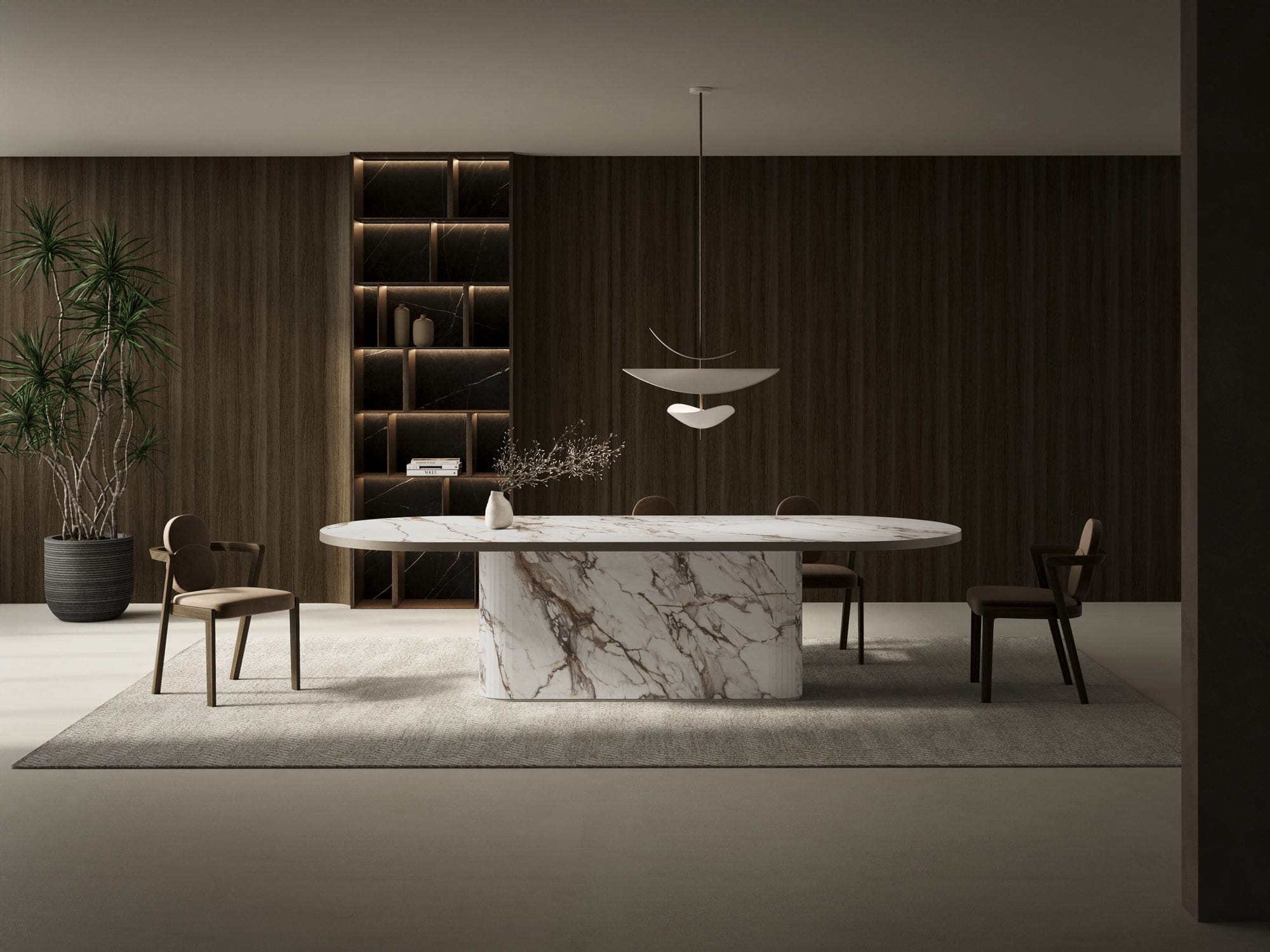
The most interesting conversations I’ve had lately aren’t about which Italian marble to specify or whether walnut has overtaken oak in desirability. They’re about something far more fundamental: why the dining table has suddenly become the most considered purchase in the entire home.
Something shifted during the past few years. The dining room stopped being that formal space reserved for Christmas and special occasions. It became, quite simply, where life happens. And once that realisation took hold, the idea of settling for a mass-produced table started feeling absurd.
Beyond Marble: The Material That’s Changing Everything
For generations, the pinnacle of dining luxury meant one thing: a slab of exquisite marble balanced on an elegant base. Beautiful, undeniably, but also problematic. Red wine stains that require immediate attention. Hot serving dishes that need trivets. The anxiety of watching guests place glasses directly on the surface.
Enter Italian porcelain stoneware, and suddenly the rules change entirely.
This isn’t the porcelain of your grandmother’s teacups. Modern porcelain stoneware captures every nuance of Calacatta marble or Travertine stone, reproducing the drama of natural veining and the authenticity of geological formation with such precision that even seasoned designers struggle to distinguish it from quarried stone at first glance. Yet it handles red wine spills, hot casserole dishes, and daily family life without the slightest concern.
The technical advantages read like a wish list: completely non-porous, impervious to staining, heat resistant to extreme temperatures, scratch resistant enough for cutting boards, and requiring absolutely no sealing or special maintenance. But what truly matters is the freedom this provides. Your dining table becomes a surface you actually use rather than one you anxiously protect.
The New Bespoke: Design Freedom Meets Material Intelligence
The traditional bespoke furniture commission followed a familiar pattern: multiple consultations, hand-drawn sketches, months of waiting, and a final result that you hoped would match your vision. Exciting, certainly, but also daunting and opaque.
What’s emerging now represents something more democratic yet equally sophisticated. Using advanced 3D configurators, you can design your perfect table in real time, seeing exactly how different surfaces, bases, and proportions work together before committing. It’s bespoke without the guesswork, custom without the anxiety.
This technological approach doesn’t diminish craftsmanship; it enhances it. Every table remains individually made to order, handcrafted by skilled artisans who’ve mastered the exacting requirements of working with porcelain. The difference lies in transparency and control. You’re not hoping the maker understood your vision; you’ve seen it rendered in three dimensions from every angle.
The marriage of Italian design sensibility with British manufacturing precision creates something particularly compelling. Italian porcelain brings centuries of ceramic mastery and an innate understanding of material beauty. British craftsmanship contributes engineering excellence, meticulous attention to detail, and the kind of quality control that ensures each table meets exacting standards.
Why Shape Matters More Than You Think
Walk through any furniture showroom and you’ll notice something curious: nearly everything is rectangular. It’s the default shape, the safe choice, the option that offends nobody and excites nobody.
Custom design liberates you from these conventions.
Circular tables dissolve hierarchy entirely. Every seat holds equal importance; conversation flows naturally without the awkward head-of-table dynamics that rectangular forms create. For homes where dining is genuinely social rather than formal, the circle becomes quietly revolutionary.
Stadium shapes offer something more nuanced. The elongated oval creates intimate conversation zones at each curved end whilst maintaining generous central seating. It’s the geometry of inclusion, designed specifically for the way modern families and friends actually interact around food.
Even rectangles become more interesting when their corners curve gently, softening the room’s geometry whilst eliminating those sharp edges that always seem to find your hip in the dark.
Shape isn’t merely aesthetic preference; it’s social engineering through furniture design.
The Four-to-Six Week Advantage
Mass-produced furniture operates on a curious premise: that immediate availability justifies compromising on exactly what you want. Order now, receive within days, settle forever.
The custom approach inverts this logic entirely. A four-to-six week lead time becomes not a disadvantage but a feature. It’s the time required to craft something specifically for you, to ensure every detail meets standards that mass production simply cannot maintain.
During those weeks, skilled craftspeople work exclusively on your table. Porcelain surfaces are precision-cut, edges are hand-finished, bases are carefully engineered and assembled. Quality cannot be rushed, and anyone who’s lived with truly well-made furniture understands that the wait adds significance rather than inconvenience.
This timeline also permits something else: anticipation. You’re not impulse-purchasing furniture; you’re commissioning a piece that will witness countless meals, conversations, and moments over decades. The waiting period allows the significance of that decision to properly resonate.
Investment Thinking: Beyond Initial Cost
The economics of bespoke furniture confound conventional consumer logic. A custom porcelain table costs more initially than its mass-produced equivalent, yet over its lifetime, the mathematics reverse decisively.
Consider longevity first. Porcelain stoneware doesn’t wear, fade, or require refinishing. Unlike natural stone that needs periodic sealing or timber that demands regular maintenance, porcelain simply endures. The table you commission today will look essentially unchanged in twenty years, thirty years, perhaps longer.
Factor in the elimination of replacement costs. Mass-produced furniture typically survives five to seven years before style changes, wear, or simple dissatisfaction prompts replacement. A well-designed custom table transcends fashion cycles entirely. Its quality and personal significance ensure it remains relevant regardless of shifting trends.
Then there’s the intangible appreciation. A dining table where your children grew up, where family celebrations unfolded, where friendships deepened over long dinners accumulates value that defies monetary calculation. It becomes not merely furniture but a repository of your life’s narrative.
The Sustainability Imperative Nobody Discusses
Sustainability conversations in furniture typically focus on certified timber or recycled materials. These matter, certainly, but they miss the more fundamental point: the most sustainable furniture is that which never needs replacing.
Porcelain stoneware embodies this principle completely. Manufactured using sustainable processes without harmful materials, requiring no chemical treatments or sealants throughout its lifetime, and designed for essentially permanent use, it represents sustainability through longevity rather than marketing messaging.
When you commission a table designed to outlast you, potentially serving multiple generations, you’ve made perhaps the most environmentally responsible furniture decision possible. Every year that table remains in use is another year without the resource extraction, manufacturing, shipping, and waste associated with replacement furniture.
Your Story, Unscripted
The tables we commission don’t just furnish our dining rooms; they set the stage for the unscripted moments that define our lives. The spontaneous Tuesday dinner that stretches past midnight. The difficult conversation that somehow becomes easier across a shared meal. The celebration that matters not because it was planned but because everyone who mattered was there.
Custom dining furniture, particularly when crafted from materials as forgiving and beautiful as Italian porcelain stoneware, removes the barriers between intention and experience. You stop worrying about protecting your investment and start actually living with it.
That freedom to use your dining table fully, combined with the satisfaction of owning something designed precisely for your space and sensibility, explains why bespoke has moved from niche luxury to considered standard among those who take their homes seriously.
The question isn’t whether custom dining furniture costs more initially. It does. The question is whether you’d rather own something adequate or something exactly right. For an increasing number of discerning homeowners, that’s not really a question at all.

